

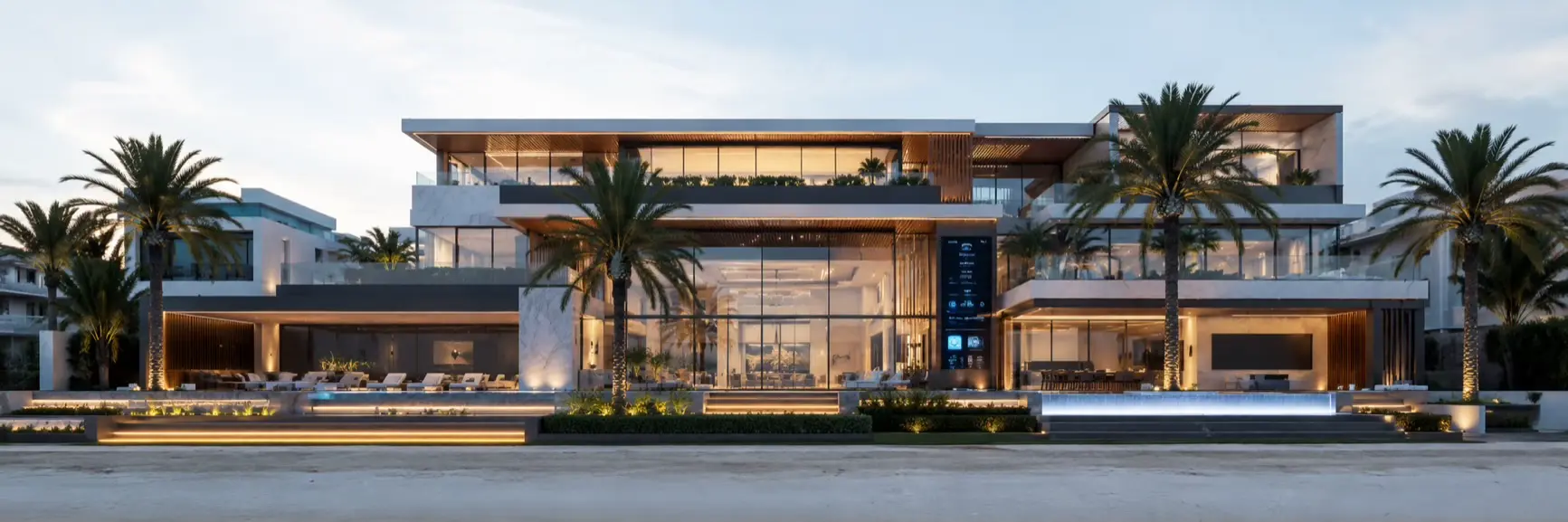
As luxury architecture in Dubai continues to evolve, Smart Facade systems are becoming a key element in creating energy-efficient, sustainable, and technologically advanced buildings. This article explores how intelligent facade technologies are transforming luxury villa design and shaping the future of architecture in the UAE.
1. Introduction: The Evolution of the Building Envelope
For decades, the facade was perceived primarily as an aesthetic component — a visual statement defining architectural character. However, in cities like Dubai, where environmental conditions are extreme and architectural standards are exceptionally high, the facade has evolved into a sophisticated performance system.
Today, a Smart Facade in Dubai is not merely about appearance. It is a climate-responsive, technology-integrated envelope that directly influences energy efficiency, thermal comfort, daylight optimization, and property value.
Luxury architecture is no longer defined solely by scale or material selection; it is defined by intelligence. The building envelope must now respond, adapt, and perform. This shift represents a fundamental transformation in how architects and developers approach high-end residential design.
2. Understanding Smart Facade Systems
A Smart Facade — often referred to as an intelligent building envelope — is an adaptive exterior system capable of dynamically responding to environmental stimuli. Unlike traditional static facades, smart systems are integrated with sensors, automation technologies, and control algorithms.
These systems continuously monitor variables such as:
- Solar radiation intensity
- Outdoor temperature
- Wind pressure
- Interior thermal conditions
- Daylight levels
Based on real-time data, the facade can adjust shading devices, modify glass transparency, regulate ventilation cavities, or activate integrated photovoltaic panels.
Rather than serving as a barrier between inside and outside, the Smart Facade becomes a mediator — balancing environmental exposure with interior comfort. In hot climates like the UAE, this dynamic capability is not a luxury; it is an engineering necessity.
3. Why Dubai’s Climate Demands Intelligent Facade Solutions
Dubai presents one of the most challenging climatic environments for architectural design. With prolonged periods of intense solar radiation, high ambient temperatures, and substantial cooling loads, conventional facade systems often underperform.
Luxury villas in Dubai frequently feature expansive glazing to maximize views and natural light. While visually striking, such designs dramatically increase solar heat gain if not carefully managed.
An energy-efficient facade in Dubai must simultaneously:
- Preserve panoramic views
- Control glare
- Minimize heat transfer
- Reduce HVAC dependency
- Maintain architectural clarity
Smart Facade systems address these competing demands by integrating responsive technologies that regulate solar gain throughout the day. By reducing peak cooling loads, these systems directly lower operational energy consumption while enhancing occupant comfort.
In a region where air-conditioning can account for the majority of a building’s energy use, facade intelligence significantly impacts performance metrics.
4. Core Technologies Behind Smart Facades
The effectiveness of a Smart Facade lies in the synergy between multiple integrated technologies.
Electrochromic glass, for instance, allows glazing to adjust its tint dynamically. Rather than relying on blinds or curtains, the glass itself responds to solar intensity, reducing glare and solar heat gain while preserving unobstructed views. This is particularly valuable in luxury villa facade design, where visual continuity between interior and exterior is paramount.
Automated shading systems further enhance performance. These may include motorized louvers, sliding screens, or kinetic panels that track the sun’s movement. Unlike static shading, adaptive systems optimize solar control seasonally and hourly, creating a facade that visually transforms throughout the day.
Another advanced solution is the Double Skin Facade, increasingly adopted in high-end developments across the UAE. By incorporating two layers separated by a ventilated cavity, this system acts as a thermal buffer. The cavity can dissipate heat before it reaches the inner layer, significantly improving insulation performance while also enhancing acoustic comfort.
Additionally, Building-Integrated Photovoltaics (BIPV) embed solar technology directly into the facade. In Dubai’s sun-rich environment, this integration transforms vertical surfaces into energy-generating assets. Rather than adding solar panels as external equipment, they become part of the architectural language.
The intelligence of the facade is ultimately governed by integrated sensors and Building Management Systems (BMS). These systems ensure that facade components operate cohesively, responding to environmental fluctuations in real time.
5. Energy Performance & Sustainability Impact
Sustainability in Dubai is no longer a marketing narrative — it is a regulatory and economic reality. Smart Facades contribute substantially to sustainable architecture by reducing cooling loads, improving daylight harvesting, and supporting renewable energy integration.
Studies indicate that optimized facade systems can reduce overall cooling demand by up to 30–40% in hot climates. Beyond energy savings, intelligent envelopes also improve indoor environmental quality, maintaining stable thermal conditions and reducing glare-related discomfort.
In high-end properties, sustainability also enhances brand positioning. Developers increasingly highlight energy performance metrics as part of their value proposition. A Smart Facade demonstrates forward-thinking design, aligning with global ESG standards and green building certifications.
For investors and end-users alike, energy efficiency translates into measurable financial advantages over the building’s lifecycle.
6. Smart Facades in Luxury Villa Architecture
Luxury villa architecture in Dubai is defined by openness, transparency, and seamless indoor-outdoor integration. Floor-to-ceiling glass, open-plan interiors, and fluid spatial transitions are hallmarks of contemporary design.
However, these architectural choices intensify environmental exposure. Smart Facade systems enable architects to preserve minimalist aesthetics while optimizing environmental performance. Expansive glazing can coexist with solar control technologies that dynamically regulate heat gain.
Furthermore, adaptive facades enhance privacy without sacrificing design clarity. Smart shading can adjust based on occupancy patterns, ensuring discretion when needed. In this context, the facade becomes a key contributor to experiential luxury — not only visually impressive but technologically refined.
7. Design Expression: When Engineering Enhances Beauty
Far from limiting creativity, Smart Facade technologies expand architectural possibilities. Parametric shading patterns, perforated kinetic panels, and layered double-skin compositions introduce depth and dynamism to the building envelope.
Daytime and nighttime identities can differ dramatically. Integrated LED systems can accentuate facade geometry after sunset, transforming the building into a sculptural landmark.
Responsive facades create movement, shadow play, and evolving textures. This dynamic quality elevates architecture beyond static form into performative art. In Dubai’s competitive luxury market, visual distinction is crucial. Smart Facade systems allow projects to achieve both performance excellence and iconic identity.
8. Investment Value & Long-Term ROI
From an investment perspective, Smart Facades contribute to tangible and intangible value. Operational cost reduction improves net returns. Energy efficiency increases long-term financial predictability. Sustainability compliance enhances marketability.
Moreover, high-end buyers increasingly evaluate technological integration as part of property quality assessment. A villa equipped with intelligent envelope systems signals future-readiness.
In markets driven by innovation and prestige, differentiation is critical. Smart Facade integration positions a property at the forefront of architectural advancement.
9. Technical & Strategic Design Considerations
Implementing a Smart Facade requires multidisciplinary coordination. Architectural intent must align with structural systems, MEP engineering, automation programming, and sustainability targets.
Early-stage climate analysis and performance simulations are essential. Computational modeling can predict solar exposure, optimize shading angles, and estimate energy savings before construction begins. Maintenance strategies must also be incorporated into the design process. Intelligent systems require calibration and monitoring to maintain optimal performance.
In luxury developments, precision execution defines success. A Smart Facade must be seamlessly integrated, not retrofitted.
10. The Future of Smart Facade Design in the UAE
The trajectory of architectural innovation in the UAE strongly favors adaptive, intelligent systems. Emerging advancements include AI-driven facade control, advanced photovoltaic glazing, self-cleaning nano-coatings, and biomimetic envelope structures inspired by natural organisms.
As sustainability regulations evolve and energy standards tighten, Smart Facades are likely to become baseline expectations in premium developments. In Dubai’s forward-looking architectural landscape, intelligent envelopes will define the next generation of iconic villas and landmark projects.
11. Conclusion
The Smart Facade represents the convergence of engineering, sustainability, and architectural artistry. In hot climates such as Dubai, it is not simply an aesthetic upgrade — it is a strategic response to environmental realities.
By integrating adaptive technologies, renewable energy systems, and performance-driven design, Smart Facades redefine what luxury architecture means in the 21st century.
The future of high-end construction in Dubai belongs to buildings that think, respond, and perform.
–
Frequently Asked Questions (FAQ)
What is a Smart Facade?
A Smart Facade is an adaptive building envelope that responds to environmental conditions through sensors, automation, and intelligent control systems.
Why are Smart Facades important in Dubai?
Dubai’s hot climate creates high cooling demands. Smart Facades help reduce heat gain, improve energy efficiency, and enhance indoor comfort.
Can Smart Facades improve property value?
Yes. Smart Facades can reduce operational costs, improve sustainability performance, and increase the attractiveness of luxury properties.
Are Smart Facades suitable for luxury villas?
Absolutely. They allow architects to maintain expansive glazing and modern aesthetics while optimizing environmental performance.