

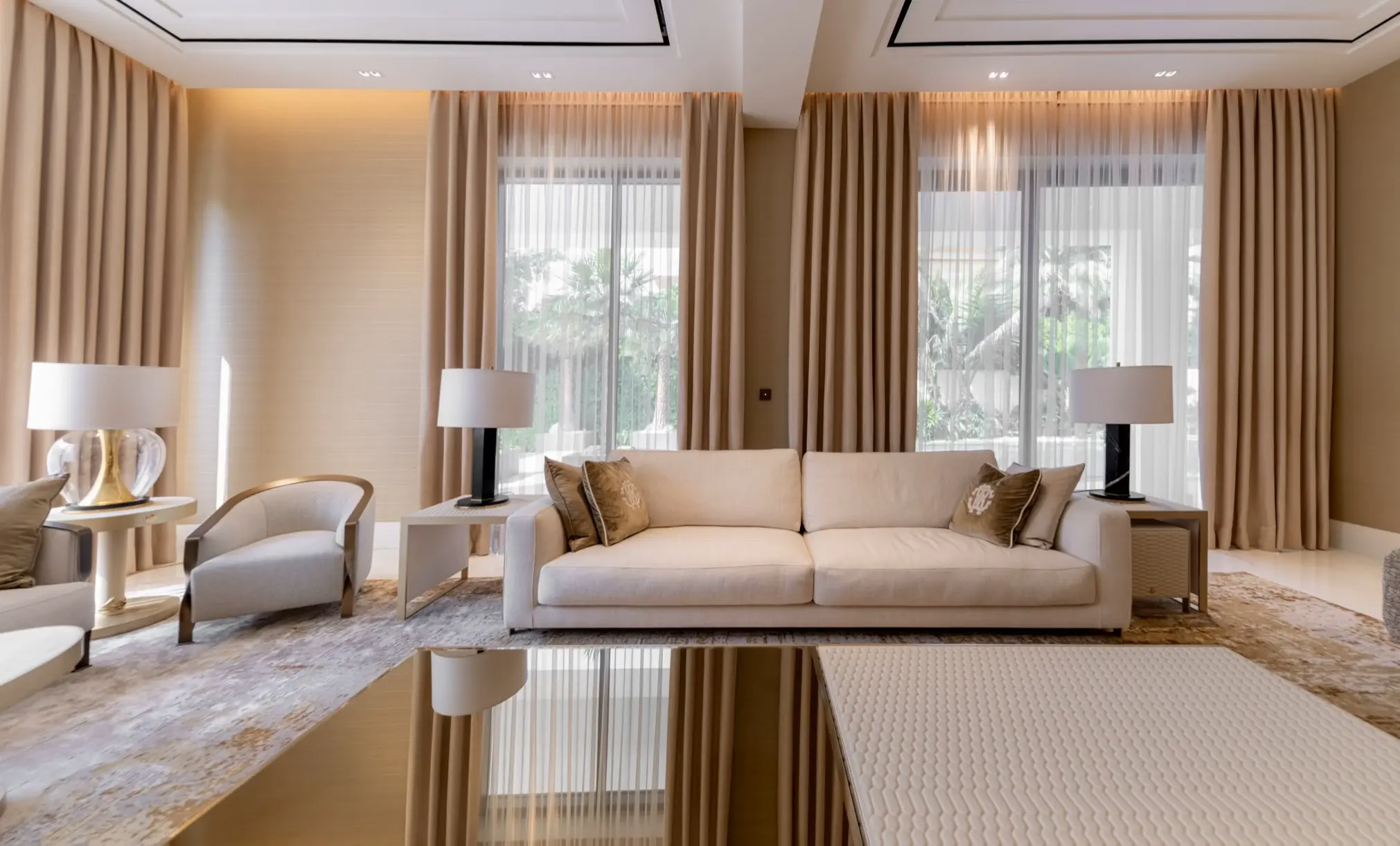
Luxury architecture is not experienced only through what people see. It is felt through atmosphere, movement, proportion, silence, materiality, and the subtle sense that everything has been considered. Before a visitor identifies a stone finish, ceiling height, or lighting detail, the mind has already formed an impression.
This is why luxury spaces must be designed not only for beauty, but also for perception. The most successful environments do not simply look refined; they make people feel calm, elevated, protected, and in control.
1. Introduction: Luxury Is Psychological Before It Is Physical
Luxury is often measured in square meters, imported marble, or advanced systems. Yet none of these elements, on their own, create the feeling of luxury. That feeling is psychological. It is formed in the mind before it is validated by logic.
A space feels luxurious when it communicates control, coherence, permanence, and refinement without effort. The emotional response precedes the conscious evaluation. Within seconds of entering an environment, individuals sense whether it is elevated or ordinary. This reaction is shaped by cognitive processing, evolutionary instincts, sensory integration, and cultural conditioning.
Understanding the psychology behind these reactions transforms architecture from aesthetic production into experiential engineering. For high-end residential and commercial projects, this distinction is critical. True luxury design is not about adding more—it is about designing with psychological precision.
2. Perception Before Evaluation: How the Brain Interprets Space Instantly
Human perception is rapid and largely subconscious. The brain scans spatial environments using pattern recognition, symmetry detection, and depth analysis. It evaluates safety, coherence, and hierarchy almost immediately.
The Three Signals of Perceived Luxury spaces that feel luxurious often share three perceptual characteristics:
– Order and visual logic
– Balanced proportions
– Material consistency
When geometry aligns, sightlines are intentional, and circulation paths are clear, the brain experiences reduced cognitive strain. This reduction in mental effort generates comfort. Conversely, environments with inconsistent finishes, unclear circulation, or disproportionate elements create subtle tension.
This is why spatial alignment matters. Even millimetric precision in joinery, lighting alignment, or stone continuity contributes to subconscious trust in the space. The mind associates precision with competence. Competence translates into perceived quality. Luxury begins with perceptual clarity.
3. Scale and Power: The Psychology of Proportion and Volume
Scale influences emotion more deeply than decoration. Volume communicates authority, freedom, and control. Studies in environmental psychology show that higher ceilings stimulate abstract thinking, while expansive rooms enhance feelings of personal significance.
Grandeur and Compression
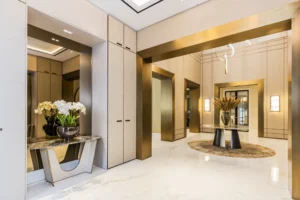
Grand entrances create psychological framing. They establish hierarchy immediately: this is a place of stature. Double-height spaces do not simply enlarge the room—they amplify presence.
However, luxury is not constant vastness. Compression is equally important. Transitional corridors, slightly lowered ceilings before entering open living areas, or controlled thresholds create contrast. This contrast heightens perception. The brain registers difference as drama.
Proportion also influences balance. Classical architecture relied on mathematical harmony for a reason: proportional systems create subconscious equilibrium. When ratios feel correct, the environment feels stable. Stability communicates permanence. Permanence signals value.
4. Material Psychology: Why Certain Finishes Signal Permanence and Value
Materials are carriers of meaning. Their psychological impact is rooted in history, scarcity, and sensory response.
Natural stone has been associated with longevity for millennia. Its density, weight, and organic veining communicate durability and authenticity. The brain reads it as “lasting.” This perception strengthens the impression of investment value.
Wood, particularly in natural finishes, conveys warmth and human craftsmanship. Unlike synthetic surfaces, it carries imperfections that signal authenticity. Authenticity increases trust.
Metals introduce precision. Brushed brass or polished stainless steel reflect light sharply, suggesting engineering accuracy. Glass suggests transparency and openness but also requires structural confidence, reinforcing perceived sophistication.
Texture and Memory
Texture influences tactile imagination. Even when not touched, the visual reading of texture activates sensory memory. Depth and richness are associated with complexity. Complexity, when controlled, enhances perceived worth.
Luxury materials are effective not because they are costly, but because they communicate narrative: endurance, craft, and integrity.
5. Light as Emotional Architecture: Neurological and Behavioural Impact
Light regulates human biology. It influences circadian rhythms, hormone production, and mood. In luxury architecture, light is both physiological and symbolic.
Natural light expands space visually and psychologically. It connects occupants to time, season, and orientation. Exposure to balanced daylight improves cognitive clarity and emotional stability. Large apertures, when strategically positioned, enhance wellbeing without causing glare or overheating.
Layered Light, Layered Emotion
Artificial lighting introduces hierarchy. Layered lighting systems—ambient, task, and accent—create depth. Highlighting architectural features directs attention intentionally. Warm colour temperatures evoke intimacy; cooler tones increase alertness.
Contrast is equally important. Soft shadow introduces dimensionality and refinement. Overly uniform lighting flattens space and reduces perceived richness.
In high-end environments, lighting is choreographed. Day-to-night transitions are designed. Scenes shift gradually. This dynamic quality transforms architecture into an evolving emotional landscape.
6. Spatial Sequencing and Emotional Rhythm in Luxury Design
Luxury spaces are rarely linear. They unfold.
The concept of spatial sequencing mirrors storytelling. A controlled entry reveals partial views. A corridor frames a focal element. A central living area opens unexpectedly into a landscape view. Each step builds anticipation.
This technique relies on controlled visibility. Humans are neurologically responsive to discovery. When an environment offers progressive revelation rather than immediate exposure, engagement increases.
Movement through space becomes experiential. The transition from public reception areas to private retreat zones reinforces hierarchy. Outdoor connections extend interior narratives. Vertical circulation—such as sculptural staircases—adds ceremonial movement.
Emotional rhythm is achieved by alternating openness with enclosure, brightness with intimacy, stillness with activity. Luxury design operates like composition in music—balanced, layered, intentional.
7. Privacy, Control, and the Architecture of Psychological Comfort
Privacy is not isolation; it is controlled exposure. Environmental psychology emphasizes that perceived control over one’s environment enhances emotional wellbeing.
Luxury spaces provide options: open entertaining zones, secluded lounges, quiet study areas, and protected outdoor courtyards.
The Value of Controlled Exposure
Layering achieves this. Landscaping screens without blocking light. Interior partitions define zones without complete enclosure. Acoustic engineering ensures that sound does not travel unnecessarily.
When occupants feel shielded from intrusion—visual or acoustic—their stress levels decrease. The space becomes restorative.
In premium residential environments, privacy is a symbol of status. It suggests autonomy. It communicates independence from external disturbance. This autonomy reinforces the psychological value of the property.
8. Multi-Sensory Integration: Designing for Subconscious Wellbeing
Luxury is multi-sensory. Acoustics play a fundamental role. Echo reduction, controlled reverberation, and sound insulation prevent cognitive fatigue. Noise pollution subtly increases stress; silence communicates refinement.
Thermal comfort is equally critical. Even temperature distribution, absence of drafts, and subtle airflow contribute to subconscious ease. Discomfort—however minor—undermines perception of quality.
The Invisible Details
Scent can also influence perception. Natural materials emit subtle olfactory cues. Landscaped courtyards introduce fresh air and organic aroma. These details enhance sensory richness without overt attention.
True luxury eliminates irritation. It creates environments where no single element demands correction. The absence of friction defines refinement.
9. Status Signalling Through Precision and Restraint
Contemporary luxury has evolved. Excess no longer guarantees prestige. Precision does.
Visible craftsmanship—tight stone joints, seamless transitions between materials, concealed mechanical systems—signals expertise. It demonstrates control over complexity.
Restraint amplifies impact. When ornamentation is minimized and detail is intentional, attention shifts to quality rather than quantity. Subtlety conveys confidence.
Status signalling today operates through refinement rather than ostentation. Bespoke elements—custom millwork, tailored lighting profiles, integrated technology—suggest exclusivity. Exclusivity increases perceived value.
Luxury is often recognized not by abundance, but by discipline.
10. Effortlessness and Cognitive Ease in High-End Environments
Effortlessness is the culmination of all previous principles.
When circulation is intuitive, storage is integrated seamlessly, and lighting adjusts automatically, occupants expend less mental energy navigating their environment. Cognitive ease produces satisfaction.
When Complexity Becomes Invisible
Hidden engineering contributes to this sensation. Advanced climate systems, acoustic insulation, and structural precision operate invisibly. What remains visible is clarity.
The brain rewards environments that are easy to use and interpret. This reward is experienced as comfort and pleasure.
Luxury is not complexity—it is the mastery of complexity made invisible.
11. Architecture as Emotional Engineering
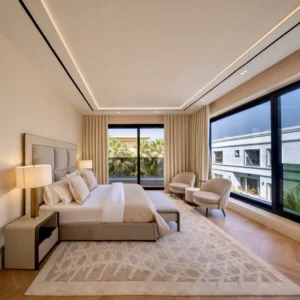
At its highest level, luxury architecture is emotional engineering. It shapes perception deliberately.
Through proportion, light, material, and sequence, architecture can:
– Increase confidence
– Encourage relaxation
– Reinforce identity
– Elevate social interactions
– Strengthen a sense of belonging
High-end projects that integrate psychological intelligence outperform those that rely solely on aesthetic ambition. The difference is subtle yet profound. Emotionally engineered spaces do not merely impress; they endure.
12. Conclusion: Designing for the Mind Before the Eye
Luxury architecture is frequently evaluated visually. Yet its most powerful effects occur invisibly—within perception, cognition, and emotion.
When spatial order reduces mental strain, when scale communicates authority, when materials signal permanence, and when environments eliminate friction, architecture transcends appearance. It becomes experience.
The most refined spaces are not defined by their cost, but by their psychological precision. They are designed for the mind before they are built for the eye.
And that is where true architectural distinction begins.
–
Frequently Asked Questions (FAQ)
What makes a space feel luxurious?
A space feels luxurious when it communicates order, comfort, permanence, control, and refinement. This feeling is not created by expensive materials alone, but by how proportion, light, movement, texture, and detail work together.
Why is proportion important in luxury architecture?
Proportion affects how the body and mind experience space. Balanced ratios create subconscious stability, while carefully controlled scale can communicate authority, openness, and emotional presence.
Does luxury design always require large spaces?
No. Luxury is not only about size. A compact space can still feel luxurious if it is well-proportioned, carefully detailed, acoustically comfortable, visually coherent, and easy to use.
Why does restraint matter in modern luxury?
Modern luxury is increasingly defined by precision rather than excess. Restraint allows craftsmanship, material quality, and spatial clarity to stand out without unnecessary visual noise.